A note grounded in the session. Finished with your judgment.
Clara accompanies the conversation and prepares a structured draft. You decide what accurately reflects the therapeutic work and mark the session as reviewed when appropriate.
From conversation to clinical record
Three calm moments that let documentation support your practice without taking centre stage.
Clara accompanies the session
Open Clara in your browser when the session begins. The conversation continues naturally while your attention stays with the person.
A clinical draft is prepared
After the session, Clara organizes what matters into a structured note shaped around your orientation and the session language.
You review and decide
Correct, expand, or rewrite anything you need. When the record represents your work, you can mark the session as reviewed.
A note shaped around how you document
The transcript provides the session material. Clara organizes it into a draft that follows your format and clinical language, without turning synthesis into an automatic decision.
- ✓SOAP, DAP, progress, or intake note formats
- ✓Language shaped around CBT, systemic, psychodynamic, and other orientations
- ✓Central themes, observations, and possible next-session focus for review
- ✓An editable draft, with the option to mark the session as reviewed when you finish
- ✓Sessions without recording: you write your notes and the session stays in the record, ready to invoice
What changes when you review the draft
An invented excerpt shows the difference between session material, synthesis and professional judgment.
01Session excerpt
Person: “Before the meeting I thought I would make a mistake. I went anyway. Preparing one idea helped. Next week I want to write those thoughts down.” Clinician: “Agreed. Record one thought and we will review its context next session.”
Fictional material containing no real person’s data.
02Illustrative draft
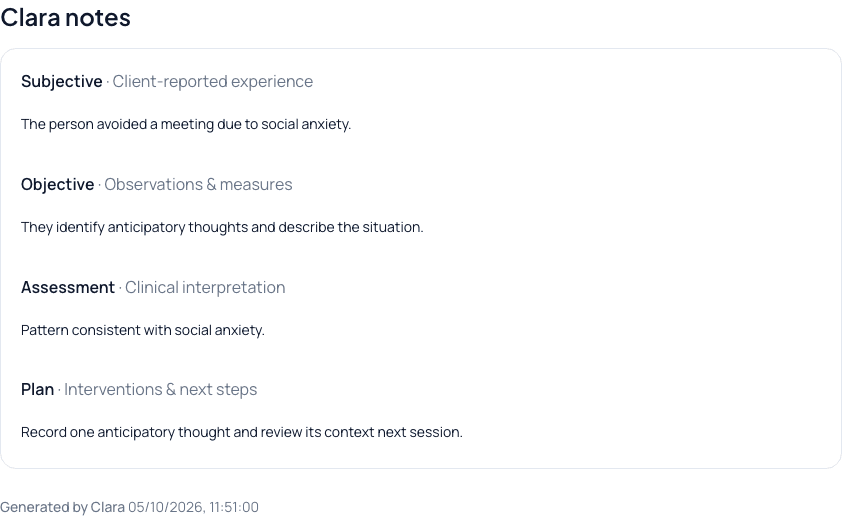
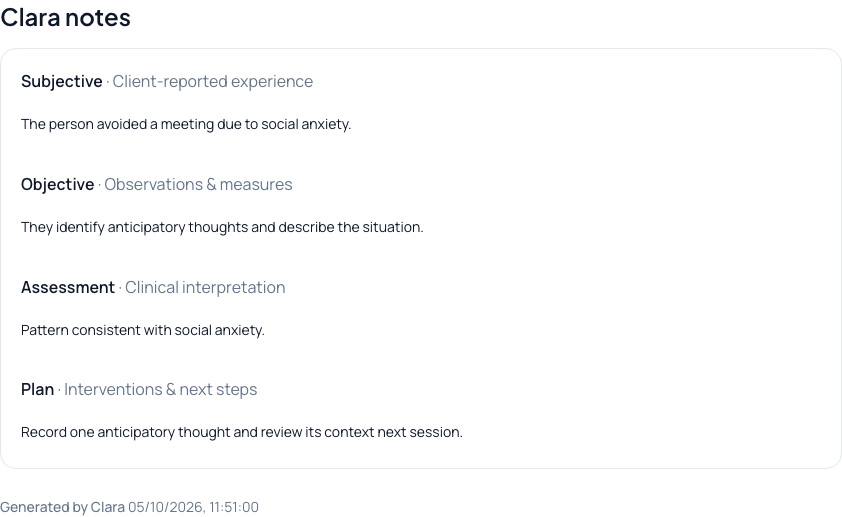
The person avoided a meeting due to social anxiety. Recording anticipatory thoughts is proposed.
This draft was written to show two possible errors. It is not a measured output from Clara.
03Record after review
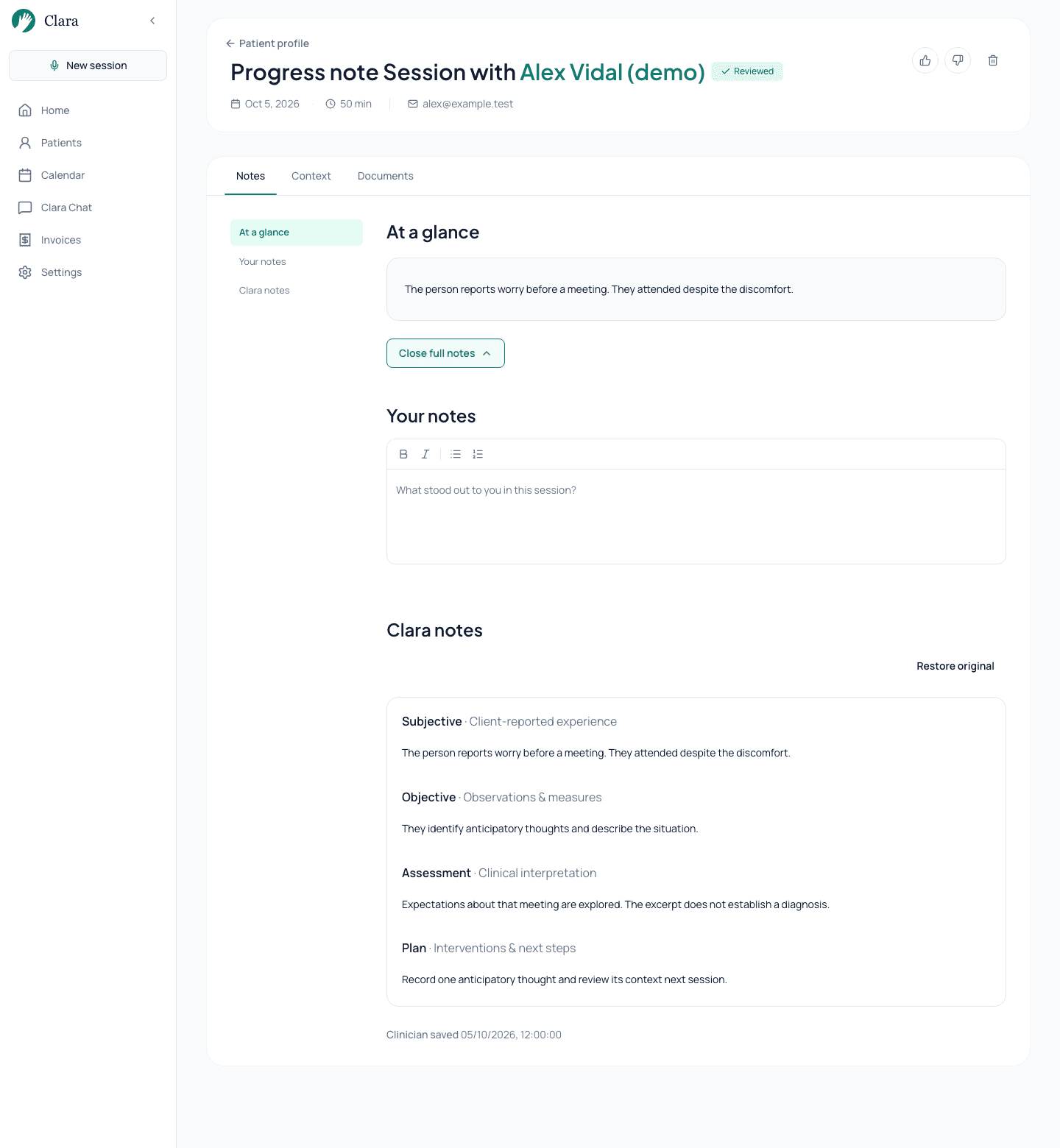
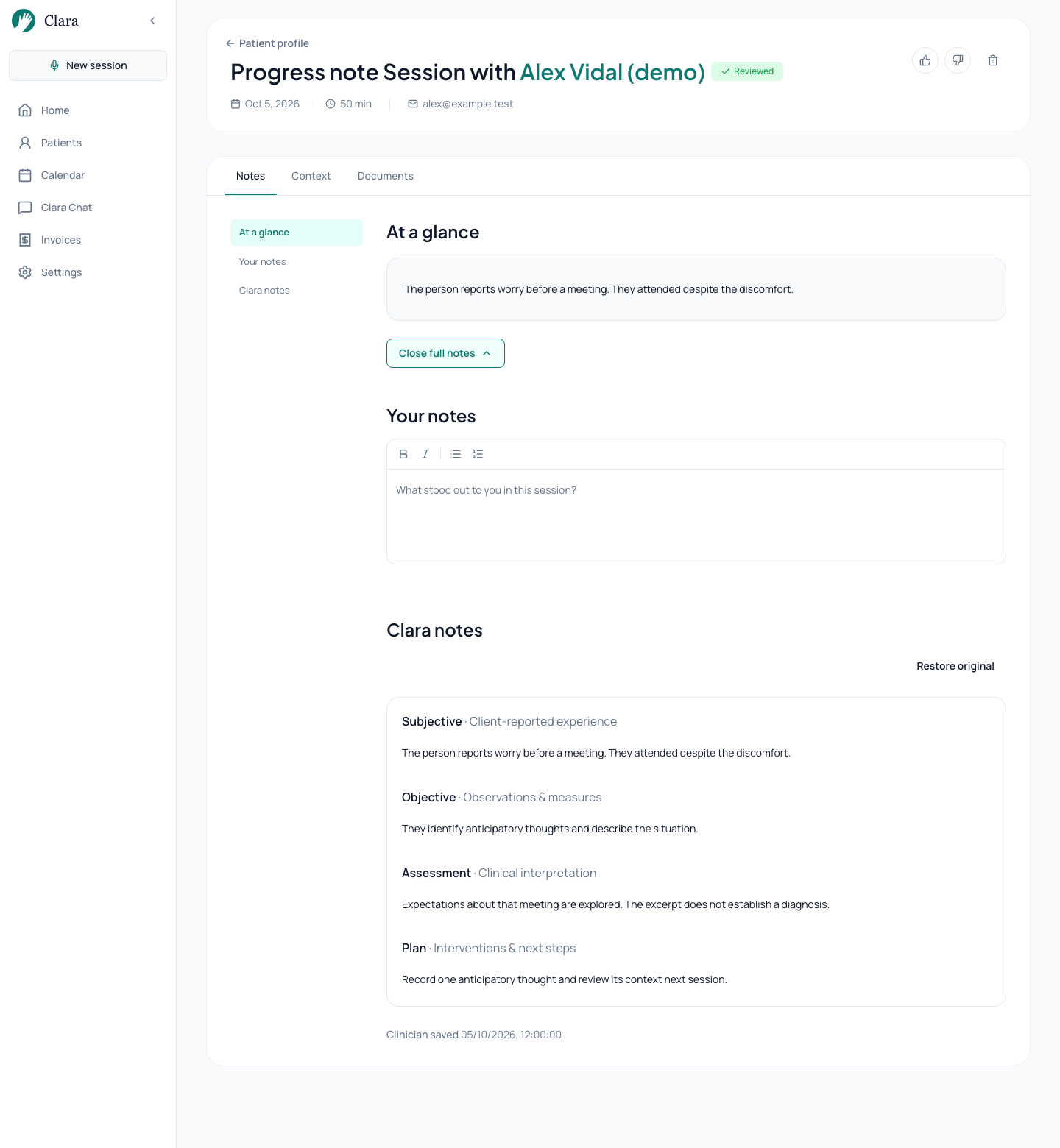
The person reports worry before the meeting and explains that they attended despite the discomfort. They identify preparing one idea as helpful. It is agreed to record one anticipatory thought and review its context next session.
Attendance is corrected, an unsupported diagnosis is removed and the agreement is preserved.
Reviewing in Clara
These screenshots show the real interface with fictional content. Review status distinguishes a session awaiting review from one you have already checked.
01Record awaiting review
Read the draft and open the sections you need to check.
Real Clara interface. Fictional data prepared for this demonstration.Open screenshot at full size → 02Reviewed session
The record retains the professional’s correction and the session is marked as reviewed.
Real Clara interface. Fictional data prepared for this demonstration.Open screenshot at full size →
Privacy explained plainly
Clinical information needs understandable boundaries. Clara protects the data and explains how it is handled.
Designed for the GDPR context
All data is hosted in the European Union. Contracted service providers process only the data needed to deliver the service and remain bound by data-protection obligations.
Encrypted in transit and at rest
Audio, transcripts, notes, and other clinical data are encrypted while being transmitted and while stored.
Clear audio-retention limits
Session audio may be stored securely on the server for up to 14 days after processing and is then deleted. A local recovery copy from an interrupted browser recording may remain on the device for up to 7 days, or be removed sooner after recovery or manual deletion.
Your data does not train models
Clinical data is not used to train models. AI prepares a draft, while final judgment always remains with the clinician.
Want to review the data-protection details? Read our practical GDPR guide →
What to check before bringing it into your practice
A useful trial does more than generate a note. It should show how much control you retain over the record and how the workflow fits your practice.
The output remains a draft
Check facts, speakers, omissions, clinical language, assessment, and plan before marking the session as reviewed.
Your practice context matters
Review client information, legal basis, professional requirements, and any permission required for your way of working.
Test the complete journey
Start with a fictional case. Generate, correct, export, and delete a session so you understand the workflow before using real client data.
Start documenting with presence.
No credit card required. No commitment. You remain in control of every note from day one.
Try Clara freeRelated resources
More from Clara
- Session transcriptionThe session, transcribed with consent
- Clinical historyCurrent after every session, with previous history
- Psychological reportsDrafts with the source of every paragraph
- Ask ClaraSearch and ask about each patient's history, with the sources cited.
- Informed consentSending, signing and records
- Calendar and remindersGoogle Calendar plus email and SMS reminders
- InvoicingInvoice every session from Clara
- Clinical software for psychologistsEverything Clara does